For many charging point operators (CPOs), OCPP 1.6 connects chargers to the CSMS, handles authorisation and metering, and gives operators the basic visibility they need to run a network. But as charging networks grow more complex: more sites, more vendors, more security requirements, more sophisticated energy management. That is where OCPP 2.0.1 comes in. OCPP 2.0.1 was released in 2020 as a major step forward from 1.6. It is not simply an extension of the old protocol; it is a redesigned framework built for a more demanding charging ecosystem.
TL;DR When Should a CPO Migrate from OCPP 1.6 to 2.0.1?
- OCPP 1.6 is still widely used and supported; it handles the core job of connecting chargers to a CSMS
- OCPP 2.0.1 is not a minor upgrade; it is a redesigned protocol built for more complex, secure and EV-centred networks
- Migration becomes necessary when security, device visibility, smart charging, Plug & Charge or future-ready requirements start to outgrow 1.6
- The best trigger is often a new charger or CSMS procurement cycle, rather than a forced mid-life migration
- OCPP 2.0.1 is an enabler, not a magic fix; uptime and driver experience still depend on operational discipline
- A good migration is phased, tested and aligned to business goals, not treated as a simple firmware update

OCPP 1.6, released in 2015, is the protocol that made large scale charging networks practical. It handles the essential loop between charger and CSMS: bootstrapping, authorisation, session management, metering, status reporting and remote commands. It also introduced Smart Charging that included load balancing and charge profiles, which allowed operators to manage energy use across sites. For many CPOs, this is still more than enough to run a stable, profitable network.
What changes in OCPP 2.0.1
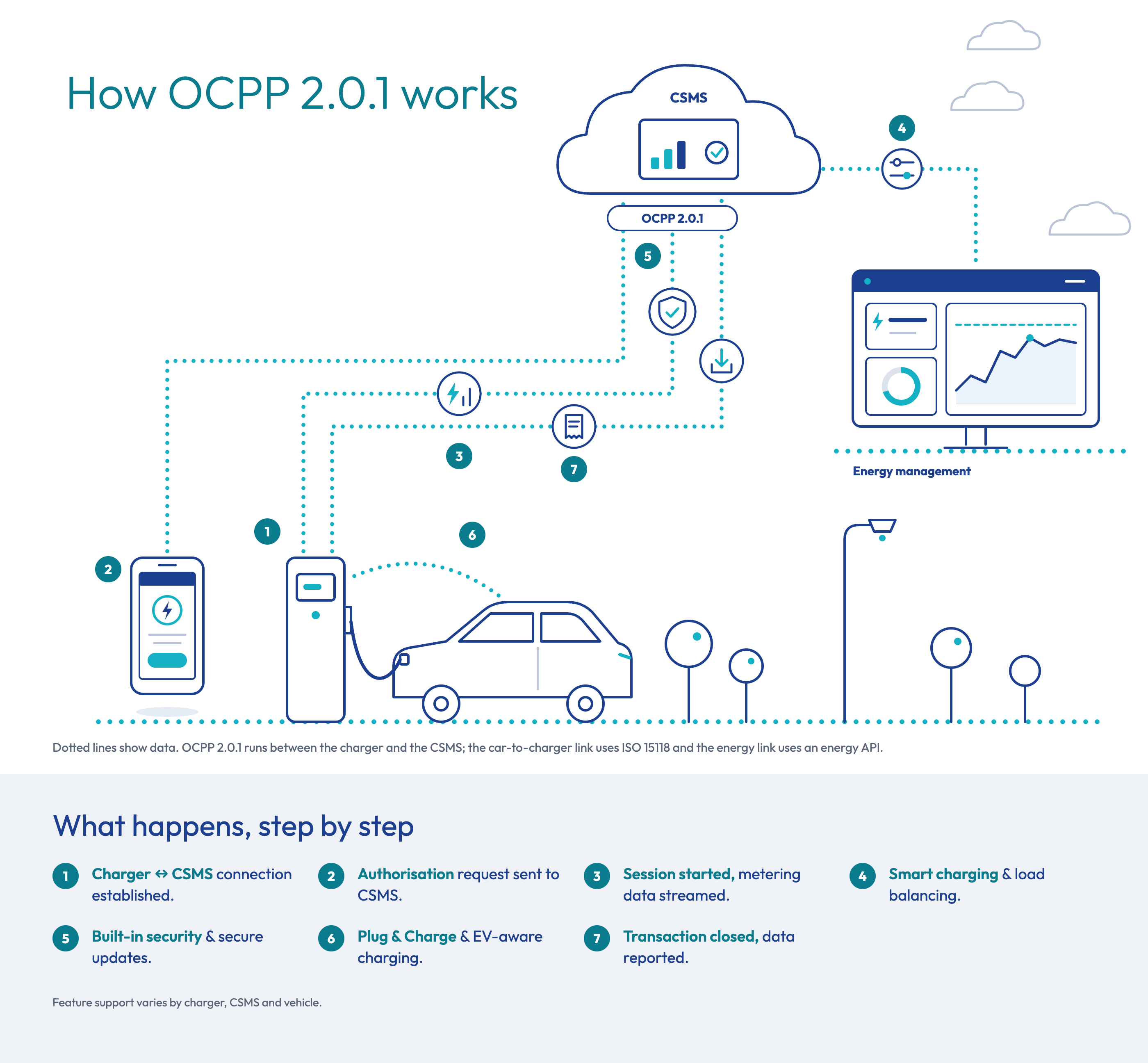
OCPP 2.0.1 is a redesign of how chargers and CSMS communicate, built for a more complex and security conscious market. The biggest shift is the device model. Instead of treating a charger as a relatively flat set of configuration keys, OCPP 2.0.1 gives operators a structured way to understand what is inside a charger: components, configuration, monitoring and error reporting. This makes it easier to manage multi-vendor estates and diagnose issues with more precision.
Other key changes include:
- More flexible transaction handling, including configurable start and stop points
- Security built into the framework, including certificates, secure firmware updates and security event logging
- Stronger smart-charging capabilities, including EMS inputs and local controller use cases
- Native support for ISO 15118-2, including Plug & Charge and EV-provided charging needs
- Better support for richer driver-facing messaging and multilingual displays
For a CPO, this means more than just new features. It means a protocol that is better suited to the kind of network they are now expected to run: more connected, more secure, and more tightly coupled to vehicle and grid behaviour.
Why OCPP 2.0.1 exists
OCPP 1.6 was designed for a market where the core job was simple: connect a charger, authorise a session, record energy, and manage the charger remotely. That remains important, but the charging landscape has changed. Networks are now larger, more heterogeneous, and more security-sensitive. CPOs are dealing with more vendors, more sites, more data, and more complex energy constraints. At the same time, vehicles are becoming more capable, and use cases like Plug & Charge are becoming more common.
OCPP 2.0.1 responds to that shift. It gives CPOs a stronger foundation for operating complex networks, especially where they need better remote management, security controls, and coordination between charger, CSMS and EV. It is also becoming the forward path for the industry. OCA says new feature development is focused on the OCPP 2.x series, while 1.6 remains supported but is not receiving new features. That makes 2.0.1 less of a “nice to have” and more of a strategic foundation for the future.
When migration becomes necessary
Migration is not automatically urgent just because 2.0.1 exists. For many CPOs, OCPP 1.6 will remain viable for existing assets, particularly where the current CSMS, chargers and workflows are already working well. The need becomes real when one or more of the following applies:
New charger or CSMS procurement
This is often the most natural point to specify OCPP 2.0.1, rather than carrying a legacy protocol into a new platform.
Stronger security requirements
If your security posture needs certificate-based authentication, secure firmware updates, or clearer security event visibility, 2.0.1 provides these more natively.
Better device visibility
If you operate a diverse, multi-vendor estate and want more consistent inventory, configuration, diagnostics and monitoring, the 2.0.1 device model is a major reason to move.
Advanced smart charging
If site-level load management, EMS integration, or more granular control of charging behaviour is central to your operations, 2.0.1 offers a more capable framework.
Plug & Charge or EV-aware charging
If ISO 15118 Plug & Charge, EV charging needs, or negotiated charging schedules are part of your roadmap, OCPP 2.0.1 provides native support rather than relying on a 1.6 customisation.
Transaction flexibility
If your commercial or operational model requires configurable transaction start and stop points, 2.0.1 was designed for that.
Future capabilities
OCPP 2.1 builds on 2.0.1 and adds support for ISO 15118-20, bidirectional power transfer, DER control and battery swapping. Starting from 2.0.1 makes that future easier to reach.
FAQ
Is OCPP 1.6 still supported?
Yes. OCA still supports OCPP 1.6, alongside 2.0.1 and 2.1.
Is OCPP 2.0.1 backward compatible with 1.6?
No. OCPP 2.0.1 is not backward compatible with 1.6, which is why migration needs to be planned carefully.
Do I need to migrate immediately?
No. If your current network is stable and your requirements are simple, 1.6 may still be fit for purpose.
What is the biggest reason to move to 2.0.1?
For many CPOs, it is the combination of better device visibility, stronger security, and native support for advanced smart charging and Plug & Charge.
Does migration improve uptime automatically?
No. Migration is an enabler, not a magic fix. Uptime still depends on charger quality, connectivity, maintenance and operational discipline.
If you’re evaluating whether OCPP 2.0.1 is the right next step for your network, Eigen Digital can help you assess readiness, plan a phased migration, and make sure the move supports your operational goals.